Garter blue and a wedge
The A4 class, and the 28th of 35
A wind-tunnel outline, an art deco class, a corridor tender, and a name Gresley thought of while feeding ducks.
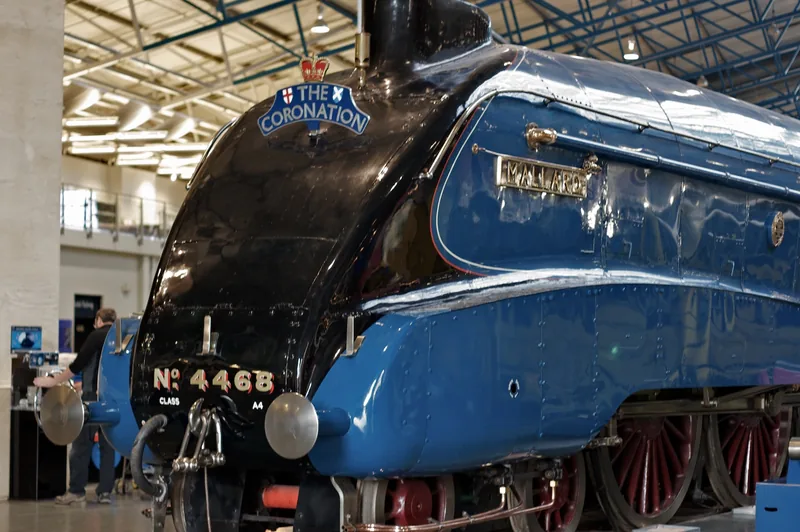
Mallard “is part of the A4 class of locomotive designed by Sir Nigel Gresley when he was Chief Engineer at the LNER.” On the same Mallard 75 page, a caption says he “was the Chief Mechanical Engineer of the London and North Eastern Railway.” [source] The archived fact sheet and the star-object page’s 2026 Gresley display also use Chief Mechanical Engineer. [source] [source] This desk quotes both titles and does not silently edit “Chief Engineer” into CME.
The outline was new. “Its innovative streamlined wedge-shaped design bore no resemblance to the preceeding A3 class (of which Flying Scotsman was an example) and was very much a product of 1930s Britain.” Speed “was seen as the ultimate symbol of modernity.” The A4 class, “aesthetically an example of art deco styling, cut the journey time from London King’s Cross to Newcastle to just four hours.” [source] The star-object page adds the workshop behind the look: the A4s “were built to power high-speed trains in the late 1930s, and their shape was honed in a wind tunnel to help them cut through the air as cleanly as possible—making speeds of 120mph and above possible.” [source]
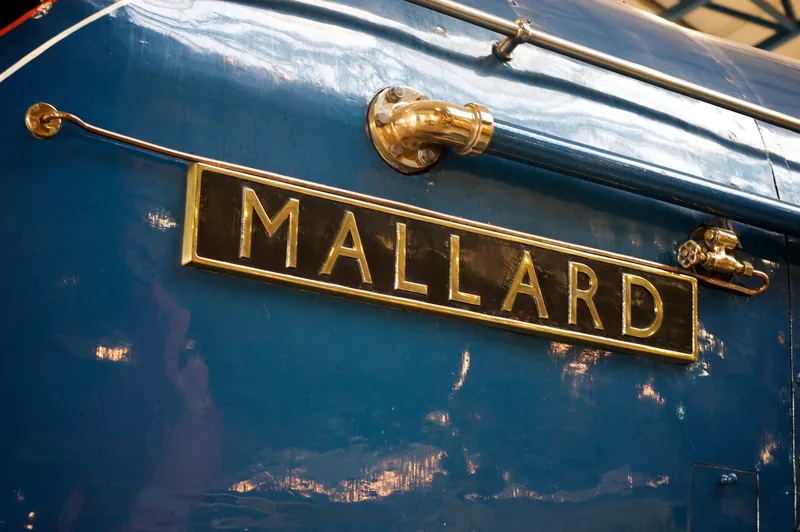
Mallard was “the 28th of the 35 A4 class of express locomotives designed by Gresley,” with “particular design features to ensure speedy passage on the East Coast Line on which it usually operated.” “An eight-wheeled corridor tender allowed the crew access to the train behind, so the team could work shifts without stopping the locomotive.” [source] An archived fact sheet is more intimate about the name: “Gresley thought of the name ‘Mallard’ when feeding ducks at Salisbury Hall.” Built at Doncaster in 1938, it “cost £8,500.” Weight, locomotive only: “102 ton 19 cwt.” Three cylinders, 18.5x26; driving wheels 6′ 8″; boiler pressure 250 lb/sq in; inventory number 1975-7007. [source]
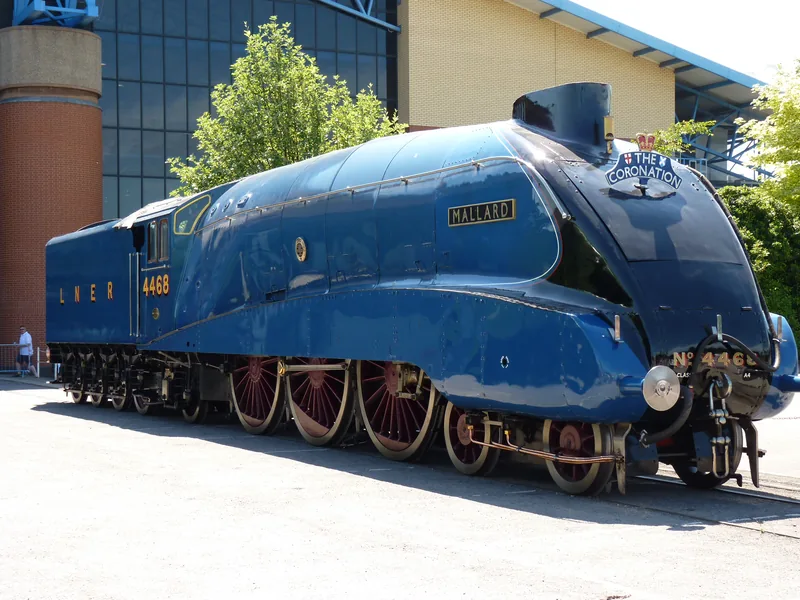
Later photographs sometimes show “The Coronation” headboard on the nose, outdoors in 2010 and in close-up in 2009. This desk treats those photographs as later display, not as the 1938 record train. The official run is a dynamometer car and a burst before Essendine, not a headboard. A typographic sheet keeps the class, the titles, and the name: The A4 and Mallard (A4) · Letter.
Enjoyed this desk on 125, 126, and a steam record that still stands in its official category?
No pop-ups. No intrusive advertising. Just interesting stuff. A little support helps the next railways.im site get built.